
Improve Seal Reliability & Eliminate Premature Failure
In heavy-duty industrial and mobile machinery, unplanned downtime rarely stems from catastrophic structural failure. More often, it starts with a weeping seal. When dynamic seals leak, the consequences ripple quickly – fluid loss, hardware damage, environmental contamination, and costly emergency shutdowns.
Improving seal reliability requires looking beyond standard catalog swaps to understand why the seal failed in the first place. With American High Performance Seals’ structured seal failure analysis, reverse engineering, and hydraulic seal performance optimization, operators can permanently resolve chronic leaks and significantly extend seal service life.
Hidden Costs of Premature Seal Failure
When fluid power and rotating equipment experience recurring seal turnover, the direct purchase cost of the seal is only a fraction of total operating expenses.
- Production Downtime: Taking a critical pump, turbine, or press offline disrupts output schedules and incurs substantial labor overhead.
- Secondary Hardware Damage: A leaking seal often allows abrasive particulate ingress, causing shaft scoring, cylinder rod gouging, and premature bearing destruction.
- Environmental & Safety Hazards: High-pressure fluid leaks create workplace safety risks, fire hazards, and regulatory compliance issues.
Achieving sustained reliability means transitioning from reactive component replacement to proactive engineered sealing solutions.
Root-Cause Troubleshooting
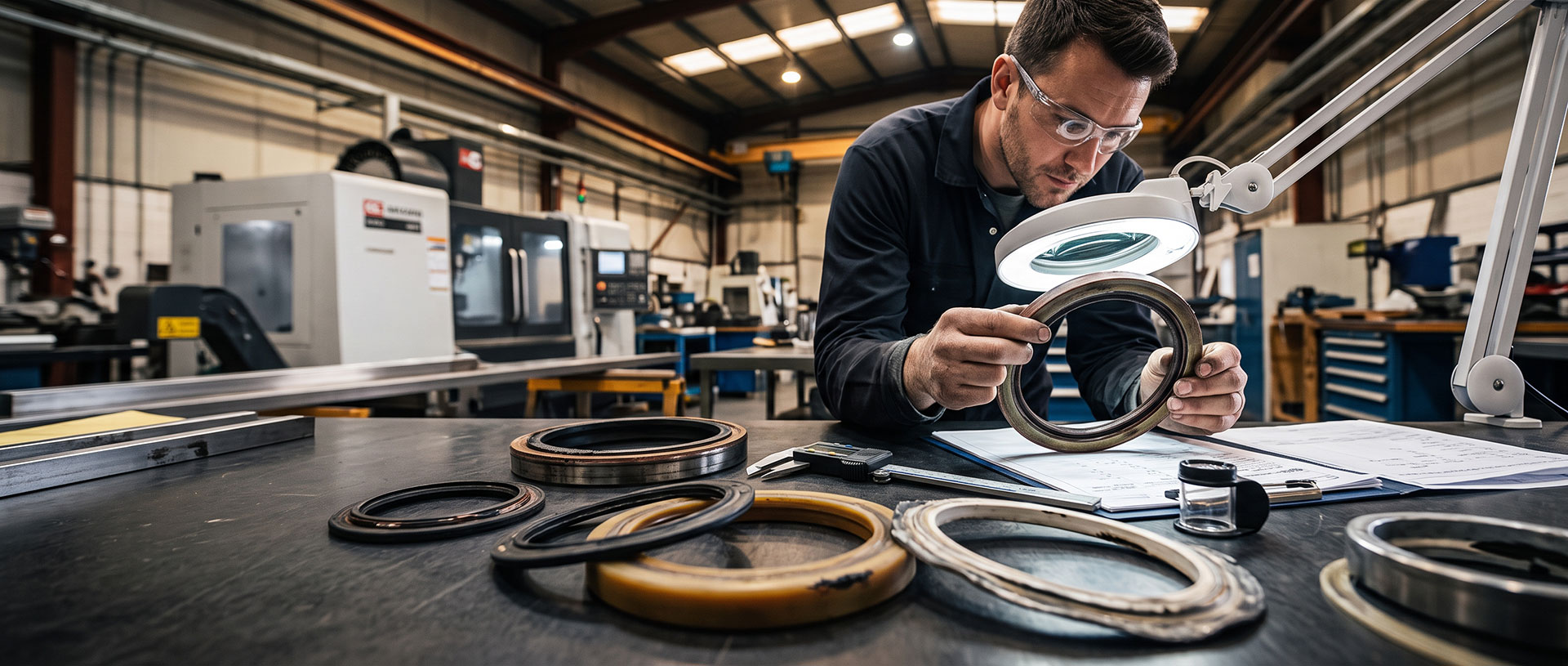
Before selecting a replacement, examining the worn or degraded component provides vital diagnostic evidence. A comprehensive hydraulic seal failure analysis inspects physical damage patterns to identify root causes.
American High Performance Seals identifies fluid changes, inadequate lubrication, contamination, installation problems, and unsuitable material selection as possible causes of premature failure. Our engineers help customers investigate the causes of premature seal failure and assess opportunities for improvement.
Before discarding a failed seal, ask our engineering team what samples, photographs and operating records would help its review. Useful information includes when leakage began, how long the seal operated and whether the problem appeared during startup, continuous operation or a particular production cycle.
Pinpointing these mechanical and material failure modes is the first step in discovering how to improve hydraulic seal life and overall system stability.
Engineering Strategies to Improve Seal Reliability
To prevent recurring breakdowns, our engineering team implements four targeted optimization strategies –
1. Upgrading Polymer & Elastomer Formulations
Standard commercial NBR or basic elastomers often break down under modern synthetic oils, aggressive additives, or elevated temperatures. Upgrading to high-performance compounds—such as hydrolysis-resistant polyurethanes, high-durometer Viton® (FKM), or filled PTFE seals – significantly boosts resistance to chemical degradation, thermal cycling, and abrasive wear.
2. Re-engineering Seal Geometry & Contact Loading
Off-the-shelf cross-sections rarely provide ideal contact pressure across both low- and high-pressure cycles. By developing custom engineered sealing solutions, engineers tailor lip angles, interference fits, and energizer spring forces to maintain positive sealing while reducing parasitic friction and heat generation.
3. Reverse Engineering Obsolete & Problematic Hardware
When working with legacy machinery, obsolete part numbers, or chronic leakage issues, reverse seal engineering provides a way to assess the original seal’s design and function, then develop a replacement that serves the equipment’s needs. American High Performance Seals offers replacement seal development for obsolete equipment components, with opportunities to incorporate newer materials where appropriate.
4. Verifying Mating Hardware Finishes
The condition of the mating surface can influence whether a replacement succeeds. Scratches, scoring and machining marks may create leakage paths or accelerate wear. Surface finish and hardness also need to suit the sealing material.
For a hydraulic pump shaft seal or other rotary shaft seals, replacing the component without examining the running surface can leave an important cause unresolved. A surface that looks acceptable during a quick inspection may still require a more detailed engineering assessment.
Define Success & Keep a Record
A practical reliability review needs a clear baseline. Give the American High Performance Seals engineering team information that allows the existing arrangement and any proposed changes to be evaluated:
- Typical operating hours between replacements.
- Leakage or wear symptoms that trigger maintenance.
- Actual pressure, temperature, speed and fluid conditions.
- Previous seal materials and design changes.
- The service interval or performance target you want to achieve.
After a change, record the operating conditions and results. This helps determine whether the improvement meets the original goal and provides a stronger foundation for future maintenance decisions.
Get Seal Technical Support
Recurring failures deserve an engineering discussion before they become an accepted maintenance expense. Whether the issue involves hydraulic pump seals, an obsolete rotary seal or changing operating demands, useful application details help guide the review.
American High Performance Seals can help assess the problem and identify appropriate custom sealing solutions. Call 412-788-8815 or email ahpseals@ahpseals.com to discuss your equipment and reliability goals.
Selecting rotary shaft seals, hydraulic seals, and other types of seals is a challenging task, unless you have extensive seal knowledge. It’s advisable to have an experienced seal engineer handle it for you.
FAQs – Improving Seal Reliability
Q: What causes hydraulic seals to fail prematurely?
A: Premature failure can result from unsuitable seal materials, fluid changes, contamination, inadequate lubrication, excessive temperature or installation damage. Actual operating conditions may also differ from the conditions used to select the original seal. Examining the failed component alongside the equipment’s service history helps identify the cause.
Q: How can hydraulic seal failure analysis improve reliability?
A: Hydraulic seal failure analysis evaluates damage patterns, operating conditions and maintenance history to investigate why a seal failed. The findings help guide changes to the seal design, material, mating hardware or maintenance practices, reducing the likelihood of repeating the same problem.
Q: Can damaged shaft surfaces cause replacement rotary seals to leak?
A: Yes. Scratches, scoring, wear and unsuitable surface finishes can create leakage paths or accelerate seal wear. When rotary shaft seals repeatedly fail, the shaft surface and its compatibility with the sealing material should be reviewed before another replacement is installed.
Q: When are hydraulic seal backup rings useful?
A: Hydraulic seal backup rings help support a seal against extrusion into a clearance gap under pressure. They may be appropriate when extrusion contributes to failure, but their material, dimensions and placement must suit the seal assembly and operating conditions.
Q: Can an obsolete seal be replaced through reverse engineering?
A: In many cases, reverse seal engineering can support the development of a replacement for a seal that is no longer available. American High Performance Seals evaluates the original design and application requirements to develop a suitable replacement. Newer materials or design changes may also provide opportunities to improve performance.
Q: Does a seal need to fail before its performance can be improved?
A: No. Seal performance improvement can address changing requirements before failure occurs. An engineering review may be appropriate when equipment must operate with a different fluid, higher temperatures or speeds, or a longer planned maintenance interval.
Q: What information should I provide when requesting seal technical support?
A: Provide hardware drawings or dimensions, fluid type, operating pressure, temperature, speed and type of movement. Include the current seal specifications, typical replacement interval, failure symptoms and desired performance goals. Photographs and failed samples may also help the engineering team evaluate the problem.